Usage example
OccuProb can also be used as a Python API and coupled to other programs that calculate the required properties. This approach is more flexible than using the CLI, since its not limited to a specific input or output format.
The following is an example script used to calculate and plot the occupation probability and the heat capacity for the isomers of a Pt5 cluster:
import numpy as np

import matplotlib.pyplot as plt

from occuprob.superpositions import SuperpositionApproximation
from occuprob.partitionfunctions import ElectronicPF, QuantumHarmonicPF, RotationalPF

# Potential energy values in eV
energy = np.array([-4433.120, -4433.012, -4432.936])
# Frequencies in THz
frequencies = np.array([[0.89, 1.53, 2.13, 3.17, 4.29, 5.41, 5.69, 6.08, 7.22],
                        [2.11, 2.13, 2.87, 2.92, 4.46, 4.52, 4.59, 5.11, 6.55],
                        [0.87, 1.07, 1.52, 3.01, 3.85, 4.35, 4.96, 5.83, 6.89]])
# Order of the rotational subgroup of the point group symmetry
symmetry = np.array([2., 6., 1.])
# Spin multiplicity
spin = np.array([3., 5., 5.])
# Principal moments of inertia
moments = np.array([[1163.57, 3017.17, 4175.72],
                    [1295.15, 2480.99, 2482.24],
                    [1170.75, 2997.96, 4168.35]])

# Electronic, vibrational and rotational contributions to the individual
# partition functions of each isomer
partition_functions = [ElectronicPF(energy, spin),
                       QuantumHarmonicPF(frequencies),
                       RotationalPF(symmetry, moments)]
superposition = SuperpositionApproximation()
superposition.add_partition_functions(partition_functions)

# Temperature range from 0 K to 1000 K, divided in steps of 1 K
temperature = np.arange(0, 1001, 1)

# Calculates the occupation probability of each isomer
occupation_probability = superposition.calc_probability(temperature)
# Calculates the heat capacity at constant volume
heat_capacity = superposition.calc_heat_capacity(temperature)

# Plots
fig, (ax1, ax2) = plt.subplots(2, 1, figsize=(5, 7), sharex=True, sharey=False)

ax1.set_ylabel(r"Heat capacity, $C_v/K_B$")
ax2.set_ylabel(r"Occupation probability, $P(T)$")
ax2.set_xlabel(r"Temperature (K)")
ax2.set_xlim((temperature.min(), temperature.max()))

# Plots the occupation probability of each isomer
for n, probability in enumerate(occupation_probability):
    ax2.plot(temperature, probability, linewidth=2, label=f"Isomer {n+1}")
ax2.legend()

# Plots the heat capacity
ax1.plot(temperature, heat_capacity[0], linewidth=2)
This script produces the following plot:
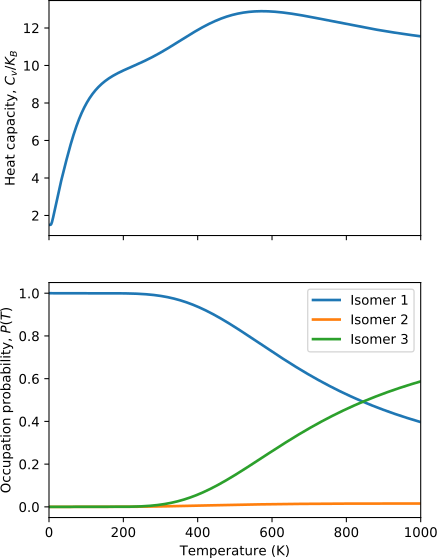
In this case, the properties of the isomers are provided as NumPy arrays. The contributions
to the total partition function of each isomer are calculated using the classes ElectronicPF,
QuantumHarmonicPF and RotationalPF. The SuperpositionApproximation class
combines the partition function contributions and provides methods to calculate the
occupation probability, the heat capacity at constant volume and ensemble-averaged
properties.